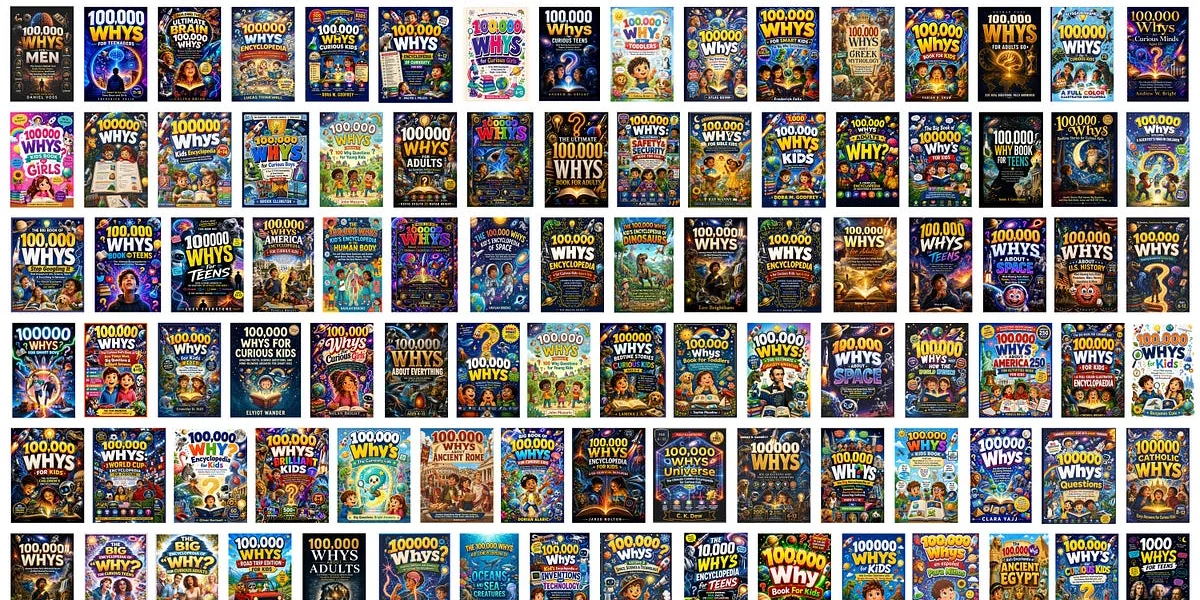
Search Amazon for "100000 whys" and you get a wall of roughly 150 near-identical children's reference books, some of them category bestsellers. Security researcher Michal Zalewski (lcamtuf) uses the collage to answer techies who insist AI text is statistically indistinguishable from human writing.
His point is that the tools are quasi-deterministic. Give a hundred "authors" the same rough prompt, say "generate a reference book for children", and the model returns functionally identical output. No single cover looks inhuman; the slop is visible only in aggregate, as repetition. Detecting one sample is hard, detecting the pattern is trivial.
That reframes the detection debate that keeps stalling. Statistical indistinguishability of a single passage can hold while the population gives the game away, which is exactly how AI content floods a category: not one suspicious book but a hundred interchangeable ones. The defence against slop may be measuring sameness, not authenticity.